
For years, discussions about housing have been dominated by interest rates, affordability and house prices.
From a developer’s perspective, the one theme that has remained remarkably consistent is strong demand for quality built-form housing.
Rather than asking whether demand exists, the more important question may be whether enough new housing can realistically be delivered to meet it.
WA housing market signals developers are watching
| Indicator | Latest available data | Why it matters |
|---|---|---|
| WA annual population growth | Australia 1.5% and WA 2.2% over the 12 months to December 2025 | WA recorded the highest annual growth rate nationally for the 21st consecutive quarter |
| WA annual population increase | International migration added 40,422 people. Interstate migration added 10,419 people, second only to QLD at 16,528 | WA population growth continues to be supported by strong migration-led demand for housing |
| Net housing supply (WA) | Estimated deficit of about 1,076 properties December 2025 quarter and 7,138 properties total deficit through 2025 (WA) | New supply is not keeping pace with demand after completions and approved demolitions were considered |
Demand hasn’t disappeared, it’s evolved
Residential demand is now coming from several directions at once. Downsizers remain an important part of the market, seeking homes that allow them to remain within established communities while reducing maintenance and improving lifestyle flexibility. At the same time, young professionals are prioritising convenience, amenity, and proximity to employment. First homebuyers continue to compete for limited stock, while established families seek opportunities to upgrade within desirable suburbs.
Australia’s Baby Boomers comprised more than 5.4 million people, or 21.5% of the population, at the 2021 Census. Not all will downsize, but the size of this cohort means changing housing needs through later life are likely to remain relevant to demand for well-located, low-maintenance homes.
Importantly, housing markets function as an ecosystem. When a downsizer moves from a large family home into a well-designed apartment or townhouse, that home becomes available to another family. That family may in turn vacate a smaller dwelling, releasing stock further down the housing chain. Built-form housing can therefore support mobility across the wider market, including upgraders and first homebuyers.
This helps to explain why demand for well-located built-form projects has remained resilient across established Perth suburbs. The buyer profiles are diverse, but the underlying preference is consistent: quality housing in locations with infrastructure, amenity and community connections already in place.
Perth’s future housing supply is increasingly an infill story
Infill and rezoning remain hot topics of debate, particularly in established suburbs where housing need, neighbourhood character, infrastructure capacity and community expectations often collide. Regardless of where individuals sit on planning policy, future housing delivery in Perth is expected to rely more heavily on infill development.
The State’s Perth and Peel @ 3.5 million framework plans for the region to accommodate about 3.5 million people by around 2050. It identifies around 800,000 additional homes, 1.2 million jobs, and sets a metropolitan infill target of 47%.
The planning framework seeks to balance greenfield and infill development while making better use of existing and planned infrastructure and supporting growth near employment, services and high-amenity areas. Recent rezoning debates across Perth are another sign of the pressure to accommodate more housing within established areas, even where views differ on the appropriate location, scale and form.
For developers, the implication is clear. More of the future pipeline is likely to involve apartments, townhouses and medium-density housing in established locations – all projects that are generally more complex to assemble, approve, service, finance and construct than conventional expansion on the urban fringe.
The supply constraints most people don’t see
Much of the public discussion around housing focuses on demand. Developers also spend a lot of their time dealing with supply.
Demand can appear, and disappear, almost overnight whereas housing supply often takes years to respond. The challenge is not simply identifying where people want to live. It is converting that demand into deliverable, economically-viable housing.
Construction cost is the largest single pressure, but the full impact is broader. Developers are dealing with a series of cost, risk, and process increases that compound across the life of a project.
The cumulative pressure on built-form feasibility
| Constraint | Effect on delivery |
|---|---|
| Construction pricing | Higher labour, materials, subcontractor and contractor risk pricing can shift feasibility materially |
| Builder appetite | Builders have become increasingly selective about build-to-sell residential work, reducing competitive tension and limiting practical delivery capacity |
| Headworks and utilities | Higher charges and project-specific upgrades increase upfront capital requirements |
| Public realm contributions | Public art, public open space, school and other community infrastructure contributions add to the cumulative cost base |
| Planning and technical inputs | More studies, consultant disciplines, design iterations, more onerous construction codes and approval steps increase cost and time |
| Finance and holding costs | Higher interest, establishment and funding costs magnify the impact of longer approval and delivery periods |
| Delivery risk | Longer programs increase exposure to escalation, market movement and changes in financing conditions |
Many individual requirements exist for legitimate reasons and can support positive community outcomes. The issue is their cumulative effect. A project can absorb one additional cost. It becomes more difficult when increased construction pricing, infrastructure charges, contributions, consultant requirements and financing costs arrive together.
Government has recognised part of this challenge through initiatives intended to unlock enabling infrastructure and housing delivery. These measures are constructive, but they operate against a much larger shift in the underlying cost of delivering built-form housing.
Internal Momentum research shows that Perth has seen a consistent and sustained level of construction cost escalation since the early 2020’s peaking at a confronting 18% p.a in the year to June 2022. Separately, January 2026 reporting based on ABS data stated that the cost of a new home in WA was 95.6% higher in December 2025 than in 2019, and that building material costs had increased 39.4% over that period.
Perth construction input prices
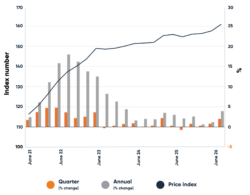
Source: ABS and Momentum Wealth research
With ongoing global geopolitical tensions and stubbornly high inflation figures, the expectation is that costs will continue to escalate in the near term.
The result is straightforward. Projects that may have been viable several years ago are often much harder to deliver today. When fewer projects stack up economically, fewer homes are built.
Replacement cost is quietly changing the market
Housing delivery stops when projects can no longer be delivered economically.
Every increase in construction and delivery costs raises the price required to make new housing feasible. As that threshold rises, projects are delayed, redesigned or do not proceed.
Over time, this can widen the gap between housing demand and supply. It can also support the relative value of existing housing and genuinely development-ready sites because comparable new product is more expensive and difficult to replace. For investors and developers, replacement cost is therefore not a technical footnote. It is one of the forces determining how much new supply reaches the market, what form it takes, and the price needed to support its delivery.
Policy is increasingly focused on new housing supply
Government policy is increasingly acknowledging that Australia’s housing challenge is a supply challenge. The National Housing Accord carries an aspirational target of 1.2 million new, well-located homes over five years from mid-2024. The Commonwealth committed $3.5 billion in payments to state, territory and local governments to support delivery towards that target.
At the same time, current federal tax settings propose to continue to permit negative gearing deductions and the capital gains tax discount for eligible residential investment, including new housing. The more important policy point for this article is not the tax treatment of an individual investor. It is that governments are using planning, infrastructure, funding and taxation settings to encourage additional housing supply, with new housing remaining central to the response.
Policy settings can assist, but they cannot eliminate the full feasibility challenge. Targets and incentives must ultimately translate into approved, financed and constructed homes.
What developers are seeing
The residential market is often viewed through house prices, interest rates, and affordability. Developers see a different picture.
We see strong demand for quality built-form housing across established suburbs. We see demand from downsizers, professionals, first homebuyers, families, and investors. We see a planning framework that increasingly relies on infill. We see higher replacement costs, constrained builder appetite and a long list of smaller costs and risks that collectively determine whether a project proceeds.
The next residential boom may not be defined by cheap debt, investor speculation, or rapidly expanding urban boundaries.
It may be defined by something more fundamental: the growing gap between housing demand and the industry’s ability to deliver new housing supply. From a developer’s perspective, that is the trend worth watching. The market may still be viewing housing as a cyclical story. Increasingly, developers are seeing a structural one.