
The Federal Budget’s move to limit negative gearing to new builds has many investors asking if they should shift their strategy toward only newly constructed properties. It’s a fair question, but one that only touches the surface of a much more complex issue.
The shine of brand-new properties being exempt from negative gearing and being able to choose between the existing 50% Capital Gains Tax discount and the new indexed method, is an easy distraction.
However, as has always been our philosophy, sticking to long-term property fundamentals of good locations, underlying land value, and proximity to amenities, which all usually align with the more established suburbs, is still proving the better investment long-term.
The numbers tell the story – established property is still likely to be a better investment.
We modelled a property bought for $900,000, with 80% loan to value ratio.
Assuming the established property grows at 6% per annum, compared to a new property that grows at 5% per annum (less land value usually means less growth). We also assumed a better yield on the brand-new property, which is normally the case.
At a five-year exit, the total return is very similar, favouring an established property by a few thousand dollars. At 10, 15 and 20-year exit strategies, established still wins by between around $20,000 and $110,000.
By changing the new property growth differential to 2%, the established property investment wins out by much more, in fact around $400,000 over the longer term.
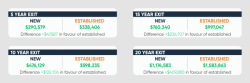
The modelling considers several assumptions on both including the cost of transfer duty, acquisition costs, yield, vacancy, maintenance, rates, income tax rates and more. Everyone’s circumstances will be slightly different, but the higher growth of established properties is likely to make them a better long-term investment.
Given that properties that the Momentum Wealth team have helped people purchase for their portfolios performed, on average, more than the market overall (in total growth), we still feel confident in the property fundamentals that quality established properties in good locations offer in terms of yield and capital growth.
Investment in property has always been popular because it offers a solid, stable asset class that buyers can tangibly see and feel. In the current shortage of new homes being built due to skills and labour shortages, material supply issues, and the escalating cost of construction – for those shifting focus to only new acquisitions – it may be years until you see anything more than a slab.
We also have some concerns about investors rushing to buy house and land packages on the fringe of major cities. These areas are likely to see an oversupply of rentals while established areas see a shortage of rental properties with fewer investors. There’s also a consideration of resale. The “brand new” property won’t be brand new anymore when it’s subsequently sold. This will narrow the pool of prospective buyers.
Of course, there’s always the chance that the policy will be reversed. The opposition parties have said they will get rid of the laws (if passed) and reintroduce negative gearing on all properties.
If you are considering investing, first speak to your broker about your options, do your homework on cashflow and your ability to manage it. Our brokers and strategists are armed with the knowledge and expertise to know how to best structure your finances and portfolio to weather big changes.
However, now more than ever, it’s important to have a strategy in place, even if it has to shift slightly. Amongst all the noise right now there will still be some great buying opportunities in the market.
By Damian Collins
Managing Director | Momentum Wealth